· Jake Sorensen
How to Use Fishing Pliers: The Moves That Matter With a Fish on the Line
Nobody teaches this. You buy a pair of pliers, clip them on, and work the rest out with a fish thrashing in one hand. The result is a set of habits that mostly work, plus two or three that quietly cost you fish, fingers and eventually the tool.
Where your hands go before the fish is alongside
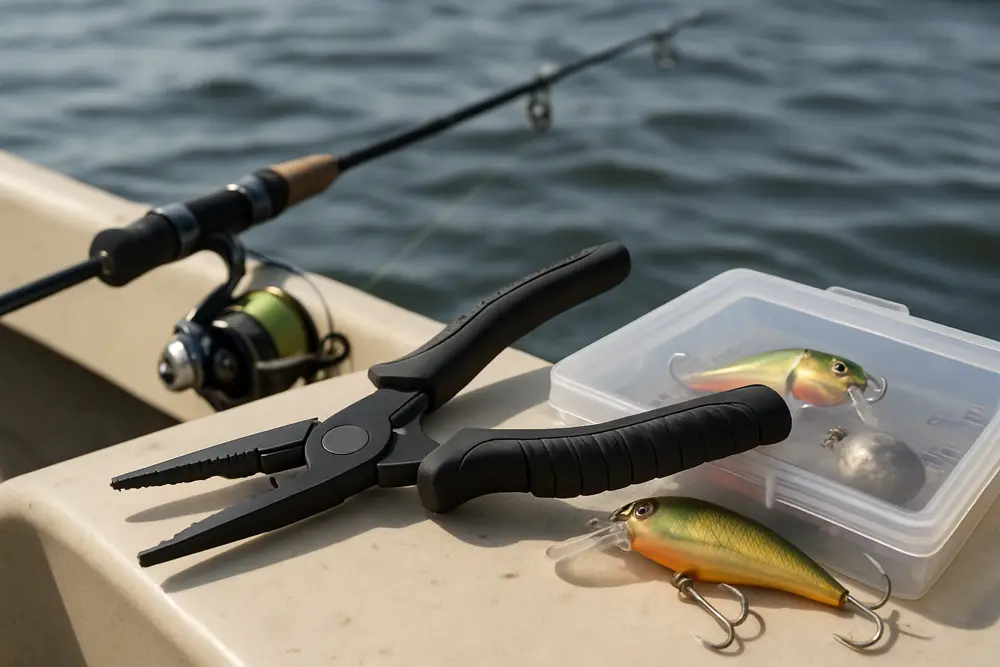
The most common unhooking problem happens before the pliers are in your hand. A fish comes alongside, one hand is committed to the rod, and the other is patting a vest down for a tool that is in a bag two feet away — all of it time the fish spends out of the water.
So the first move is positional: the tool lives where one hand reaches it in a single motion. Then the grip. Holding out at the ends of the handles gives maximum leverage and minimum precision — wrong for placing a jaw tip on a specific piece of wire. Choke up near the pivot and you get the opposite. Hook work is precision work.
Wet hands change the equation again, which is why our handles are textured TPR rather than smooth plastic. A slick handle does not fail by slipping out — it fails by rotating in your palm as you apply force, so the jaw arrives at an angle you did not choose.
Backing a hook out without tearing the hold
Start with the fish, not the hook. A fish still fighting is a moving target, and that means repeated attempts. Bring it under control first — our fish gripper guide covers the holding technique in full, so this article stays on the pliers.
Now the hook. Close the jaw on the hook itself, taking the bend or the shank depending on what you can see. That single habit puts the force you apply into the wire rather than into the fish's jaw.
The motion is not a pull. A hook goes in along a curve and comes out along the same curve. Push the shank forward a fraction first — counterintuitive, but it frees the bend from the tissue — then rotate the pliers so the point tracks its own entry path backwards. Done right it is a short twist, not a tug.
Then speed. Keep the fish wet, keep contact brief to protect the slime coat, and get the exchange over inside the time you would hold your own breath.
of recreational anglers who release at least some of their catch say fish-handling method affects survival odds
— NOAA Fisheries recreational catch-and-release guidance, 2025
What to do when the hook is set deep
Sometimes the point is out of sight. The instinct is to go looking for it with the jaw tip, and it is worth resisting: digging turns one small hold into several. If you cannot see where the point sits, the established call is to cut the line as close to the hook as you can safely reach and leave it — a two-second job that ends the handling rather than extending it.
The danger with a treble is never the point in the fish — it is the two that are not. Those are the points that find a thumb when the fish kicks. Work one point at a time, keep the free points turned away from your hand, and if the hook is tangled in mesh, cut the line first.
Flattening a barb before it becomes a problem
This is the one move that happens before you fish, and it makes every other move easier. A barb exists to stop a hook backing out — exactly what you are trying to make it do at the moment of release.
The technique is simple, the timing is everything. Take the hook in one hand, place the jaw across the barb — the small raised spur just behind the point, not the point itself — and close in a single firm squeeze rather than a series of nervous nips. Squeeze slowly: a fast snap can take the point with it.
A live barb catches and skips on a fingernail; a flattened one tracks smoothly. Do this at the tying bench, not on a rocking deck with a fish waiting. The payoff shows up twice: hooks come out in one motion instead of three, and a barbless point that finds a finger comes back out the way it went in.
Cutting mono, fluoro and braid in one closing
Three things decide whether a cut is clean, and none is how hard you squeeze. Placement: the jaw has far more mechanical advantage close to the pivot than at the tip. Tension: a slack line rolls out of the way of an edge instead of shearing against it. And commitment: one closing, no sawing.
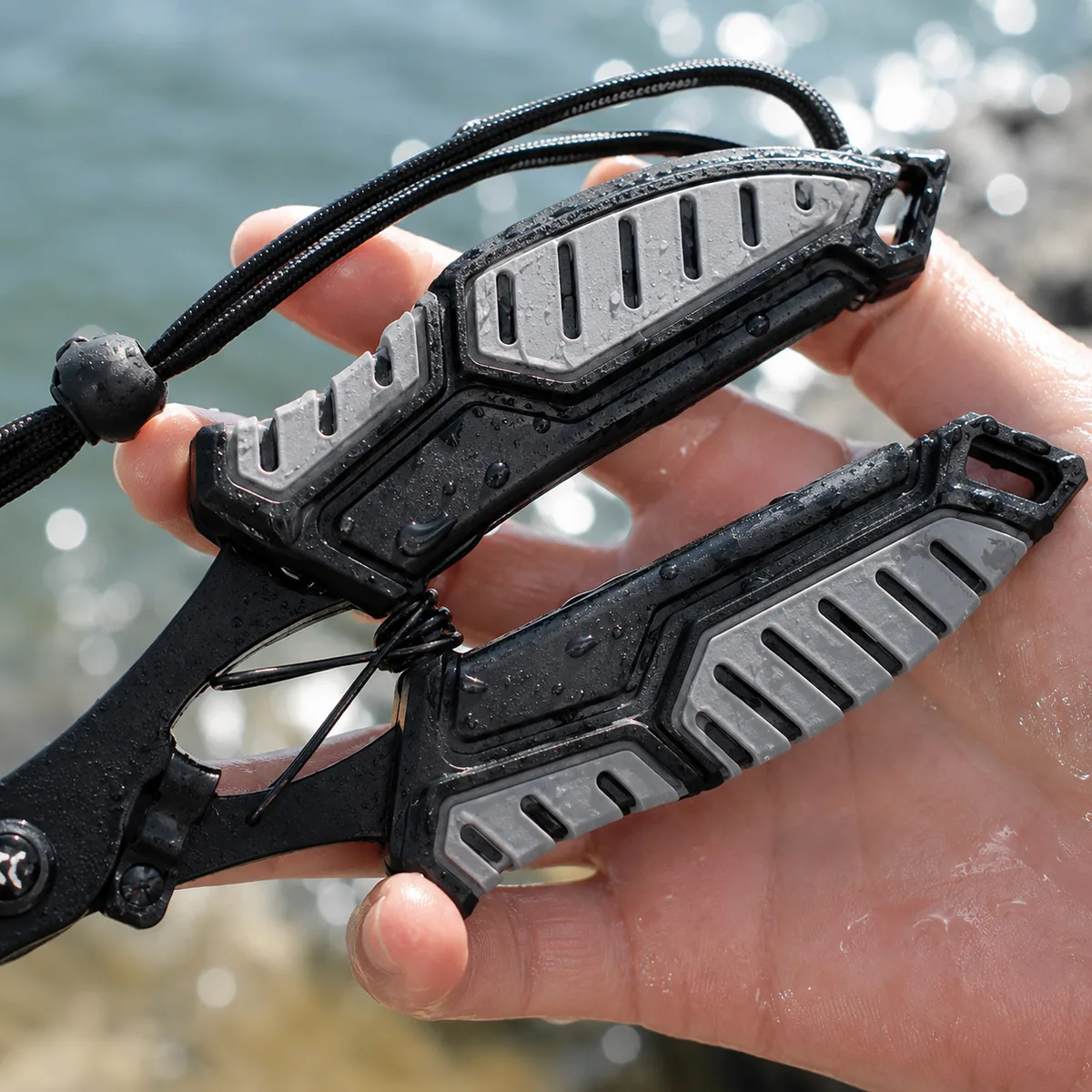
Braid punishes hesitation hardest, for reasons of material rather than technique — our pliers versus needle-nose comparison breaks down why an edge ground for solid wire struggles with woven polymer. On the water the translation is short: with braid, decide and close.
Cut the tag end closer than feels necessary on knots that will pass through guides. Our bench testing put the stainless jaw through 20lb monofilament after a 24-hour salt exposure and the cut stayed clean — methodology on how we test.
Closing a snap, and holding what your fingers can't
Between the fish and the line cut sits the work nobody photographs: closing a snap so it seats, threading a swivel, holding a hook eye still while the other hand does something useful. This is where a plier becomes a third hand.
Closing a snap is a pinch, not a crush. Bring the flat of the jaw across the snap where it overlaps, press until the wire seats home, then look at it: a snap that feels closed and a snap that is closed are not the same object. The same jaw holds a small swivel steady while cold hands thread line through it, and holds a hook by the shank so you can work on the knot instead.
Split rings are their own discipline, with their own tip geometry and failure modes — full step-by-step on our split ring pliers page.
average rating across 288 verified buyer reviews of the HookGrip lineup
— HookGrip verified buyer data, 2026
Why a pair of pliers goes over the side exactly once
Nobody drops their pliers sitting down and concentrating. They lose them standing up in a moving boat, wet hands, mid-turn, holding a fish — at which point the pliers are the least valuable thing in either hand.
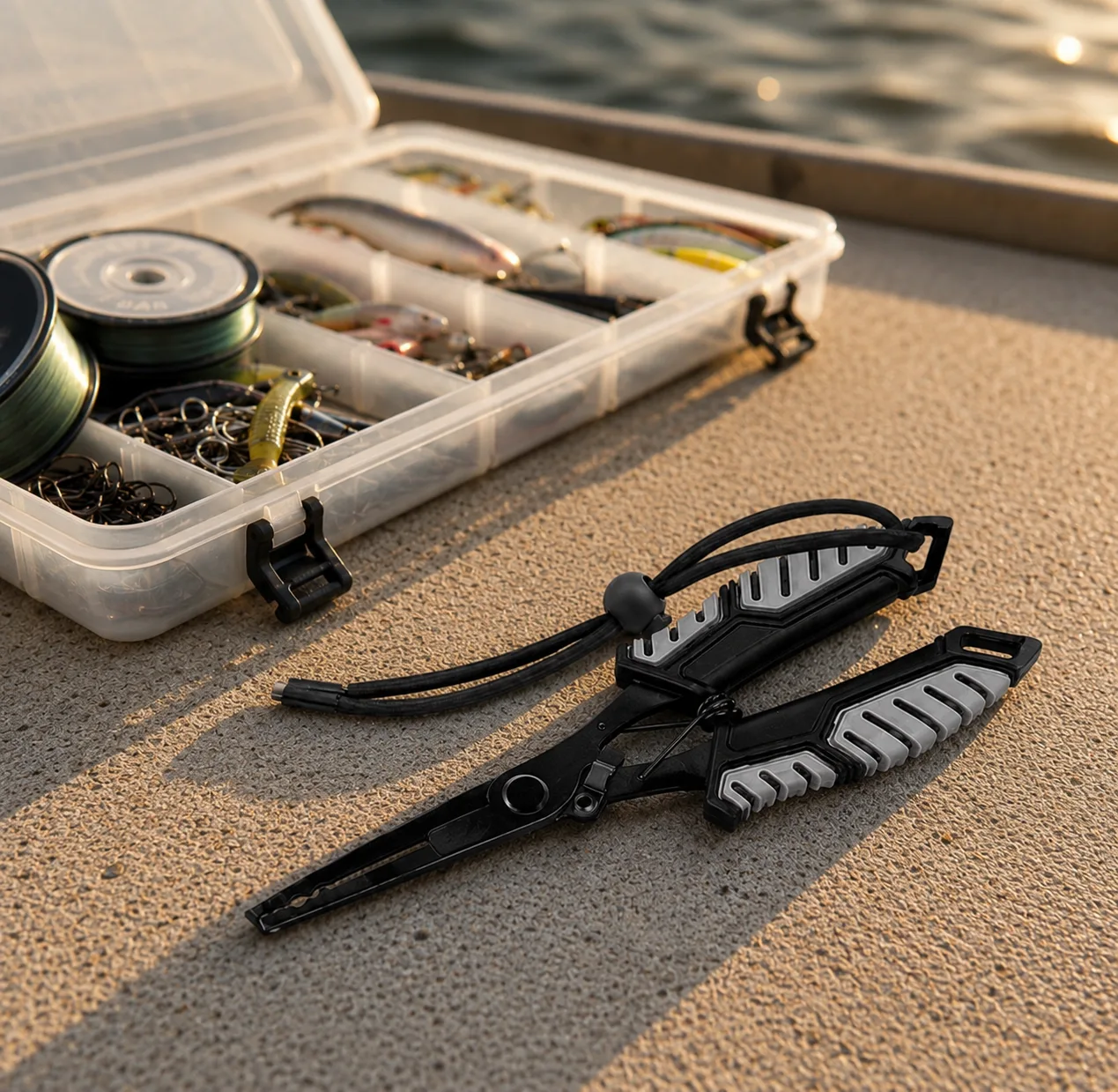
Because it is a predictable failure, it has a mechanical answer. Look at the end of the handle: there is an eyelet moulded there. That hole is the anchor point for a lanyard, and threading a cord through it turns an unrecoverable drop into a tool swinging from your vest. A coiled tether is what most anglers settle on.
The other half is where the tool goes between uses. Every HookGrip order ships with a belt pouch doing two jobs — keeping the jaw from blunting itself in the bag, and keeping the tool in one known place so the reach becomes muscle memory. Our guide to pliers with a sheath covers what a case protects.
The rest of tool care is genuinely short: rinse the jaw with fresh water after salt, dry it, and store it open rather than sealed wet. The full routine is on our stainless steel fishing pliers page and on the HookGrip pliers page.
total tool weight — light enough that a tethered plier on a vest goes unnoticed
— HookGrip product specifications, 2026
One verified buyer put the build plainly: "I am satisfied because the pliers are larger than usual. They are really strong." More photos and ratings on the reviews page.
Frequently asked questions
How do you get a hook out of a fish with pliers?
Take hold of the hook itself, not the fish, then reverse the path the point took going in: push the shank forward a fraction to free the bend, rotate, and back it out along the same curve. Pulling straight against the direction of entry is what tears the hold and costs you time.
Should I hold the pliers at the end of the handles?
Not for hook work. Choking up so your thumb and forefinger sit near the pivot trades raw leverage for control, which is what you want when the target is a hook in a moving fish. Slide back toward the ends of the handles only when you need force, such as flattening a barb.
How do you cut braided line cleanly with pliers?
Seat the line deep in the jaw close to the pivot rather than out at the tip, keep light tension on both sides of the cut, and close once with commitment instead of sawing. Braid slides away from a hesitant edge, so a single decisive closing is what gives a tag end that still threads a hook eye.
Why do fishing pliers end up in the water?
Almost always in the same moment: standing up, wet hands, one hand already holding a fish. The fix is mechanical rather than careful. Run a lanyard through the eyelet at the end of the handle, clip the other end to a vest or belt, and stow the tool in its pouch between uses.

Jake Sorensen · Outdoor Gear Tester, 7 yrs reviewing fishing tools
Jake has spent seven years testing and reviewing outdoor and fishing gear, from budget tackle to offshore-grade tools, focusing on real-world durability over spec sheets.