
· Jake Sorensen
Titanium vs Stainless Steel Fishing Pliers: Which Metal Wins
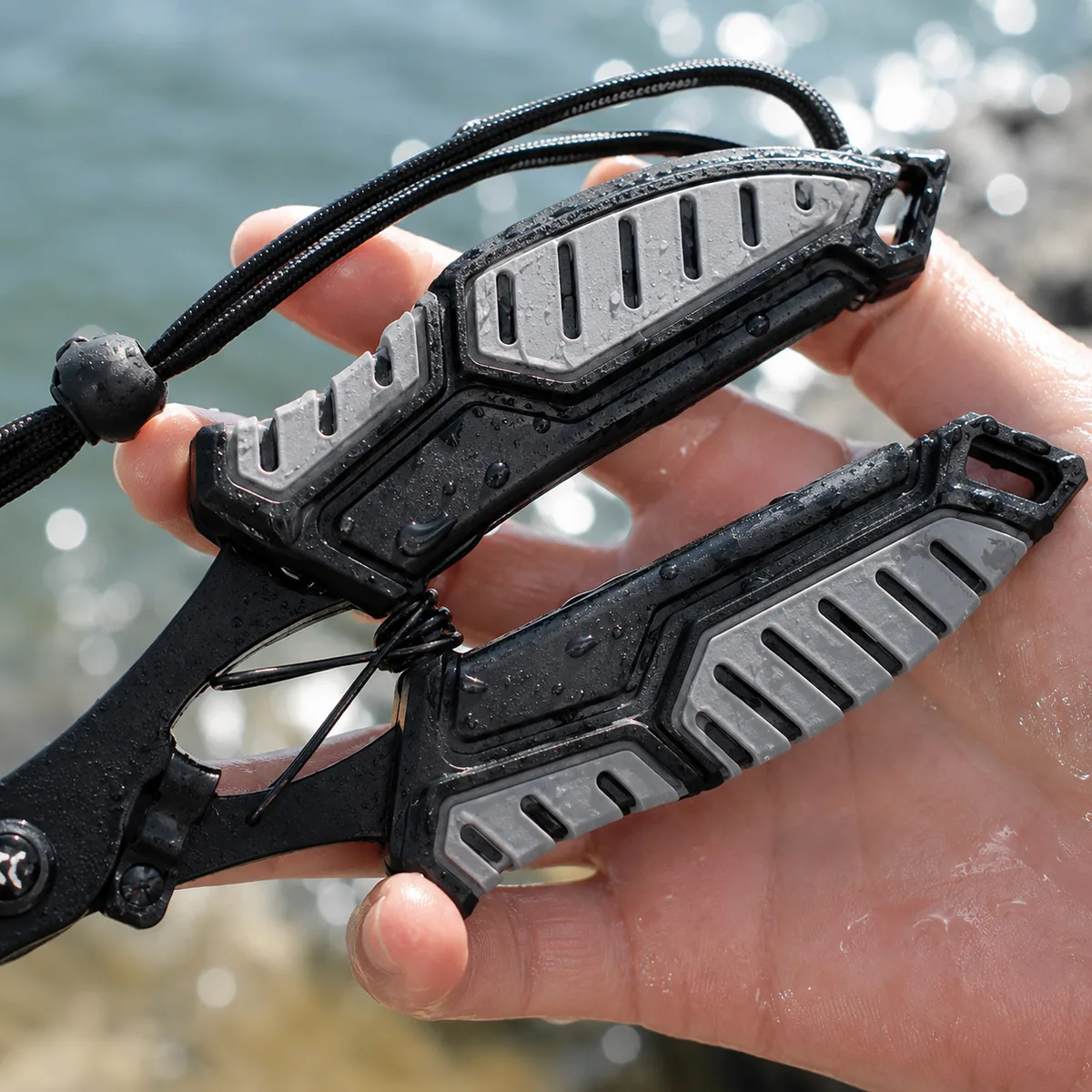
Titanium arrives in tackle the way carbon fiber arrived in rods: as a shorthand for premium, long before anyone explains what it changes. On a pair of pliers, the metal has three separate jobs — hold its shape under squeezing load, cut line cleanly, and survive salt — and titanium is not equally strong at all three. This is the straight comparison against stainless steel, job by job, with the two numbers that drive most of the difference, and a clear account of where the HookGrip build sits inside it.
The two metals, property by property
Almost everything anglers argue about here traces back to four measurable properties. Feel, finish and price all follow from them, so it helps to see them in one place before the discussion starts.
| Property | Titanium | Stainless steel | HookGrip build (ABS + stainless jaw + TPR) |
|---|---|---|---|
| Density | ≈ 4,500 kg/m³ | ≈ 7,850 kg/m³ | Composite body, steel only in the jaw |
| Stiffness (elastic modulus) | ≈ 110 GPa — flexes more | ≈ 200 GPa — holds its shape | Stiffness concentrated in the jaw |
| Cutting-edge durability | Frame metal, rarely the cutter itself | Holds an edge on braid | Stainless jaw insert does the cutting |
| Saltwater behaviour | Stays passive, no upkeep | Resists well, rinse and dry to keep it that way | ABS body cannot corrode; jaw rinses clean |
| Weight on a finished tool | Low, for a metal frame | Higher, 120–200g+ for solid builds | 90g total |
| Typical price band | Top of the category | $20–$45 | $19.95–$39.95 |
Read across the top two rows and the whole debate is already visible. Titanium buys you weight savings and pays for them in stiffness; stainless steel does the reverse. Every other difference — how the tool sharpens, how it is priced, how it ages in a wet bag — is downstream of those two lines.
What titanium genuinely does better
Titanium earned its reputation in marine and aerospace hardware for real reasons, and it is fair to state them plainly before looking at the trade-offs.
- It is light for a metal. At roughly 4,500 kg/m³ against 7,850 for stainless steel, the same frame comes out at a little over half the mass. That is the single strongest argument for the metal.
- It stays passive in seawater. Titanium grows a thin, self-repairing oxide film. Scratch it and the film reforms, which is why it is used on hardware that lives permanently in salt with no rinse routine at all.
- It does not stain the way steel can. Surface tea-staining and orange freckling, the cosmetic marks that show up on neglected steel tools, are simply not part of how titanium ages.
- Strength per gram is excellent. Titanium alloys reach steel-class strength at far lower mass, which is exactly why they end up in structures where every gram is accounted for.
Where titanium gives ground on a plier
Strength and stiffness are not the same property, and pliers care about the second one. Elastic modulus describes how far a shape deflects under a given load, and titanium sits near 110 GPa where stainless steel sits near 200. In plain terms: give both metals the same jaw geometry and the same squeeze, and the titanium jaw travels roughly twice as far before it pushes back with equal force. Designers compensate with thicker sections, which quietly gives back part of the weight advantage the metal was chosen for.
The second point surprises people: on a fishing plier, titanium is usually the frame, not the cutter. Fine cutting edges want a hard, wear-resistant material, and titanium alloys gall and smear rather than take and keep a keen edge. That is why tools built around a titanium frame carry a separate hard insert at the cutting notch. The metal in the name and the metal doing the cutting are two different things, which matters when braided line is the reason you bought the tool.
Then there is cost. Titanium is expensive to refine, expensive to machine, and slow to work, and all of that lands in the final price. A tool built from it sits above the bands the category normally runs in — the $20–$45 range where stainless steel tools cluster, and the $15–$30 range covered in our aluminum fishing pliers guide. That is a materials cost rather than a markup: the metal itself sets the floor.
Last, service. A dulled stainless edge can be touched up. A galled titanium contact face is a harder problem, and it tends to be the point where a light frame stops feeling like an advantage.
Saltwater over a full season
This is where anglers actually feel the difference, and it is the reason most people type either metal into a search bar in the first place. Titanium's oxide film keeps it passive indefinitely in seawater. Stainless steel resists salt well but not unconditionally: it relies on a chromium oxide layer that needs oxygen to stay intact, so the failure mode is a closed, wet, oxygen-starved crevice — a plier left shut and dripping in a sealed pocket for a week, exactly the storage habit that marks up tools of every brand.
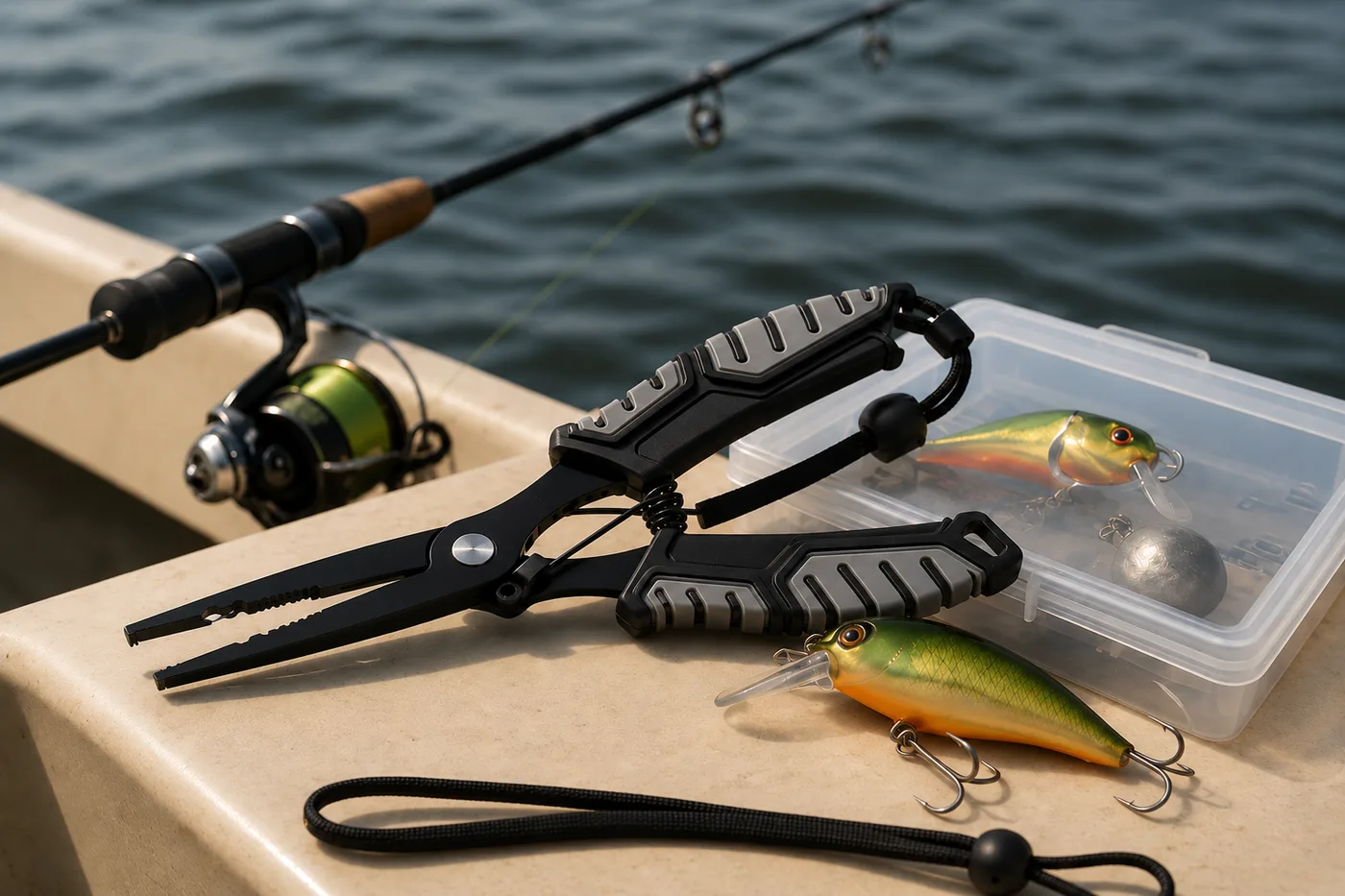
The fix is unglamorous and it works: rinse the jaw in fresh water after a salt trip, dry it, store it open rather than clamped shut and wet. We put three units through a 24-hour saltwater soak and an edge check afterwards, and the results, unit by unit, are on our stainless steel fishing pliers page along with the exact method.
One more effect belongs here, because it catches people who mix metals without thinking about it. Titanium is electrically noble. Bolt it to aluminum hardware in salt water and the aluminum corrodes faster than it would on its own — the noble metal is fine, its neighbour pays. It is a good argument for knowing what every part of a tool is made of, not only the part named in the title.
approximate density of titanium against 7,850 kg/m³ for stainless steel — the entire weight argument in one line
— ASM International materials reference, 2025
typical elastic modulus of titanium alloys against roughly 200 GPa for stainless steel: the same jaw shape deflects about twice as far
— ASM International materials reference, 2025
total weight of HookGrip pliers, ABS body, stainless steel jaw and TPR handles included
— HookGrip product specifications, 2026
“Titanium” on a listing does not always mean titanium
Two very different products share the word. One is a tool whose frame is a titanium alloy. The other is a tool made of something else and finished with a thin titanium-nitride coating — the gold or dark grey surface that also appears on drill bits. The coating is genuinely hard and genuinely thin, measured in microns. It changes the surface, and it changes nothing about mass, stiffness or how the base metal behaves once the coating wears through at the pivot and the cutting notch, which are the two places a plier rubs hardest.
Three checks separate the two without any special equipment:
- Weigh it against its size. Density is the tell that cannot be faked. A full-size metal-framed plier that weighs like solid steel is solid steel underneath, whatever colour the surface is.
- Do not lean on a magnet. A magnet separates plain steel from the rest, but titanium and aluminum are both effectively non-magnetic, and several stainless grades are only weakly magnetic. The test that people cite most often is the one that answers the least here.
- Read the component list, not the title. A spec sheet that names a material for the body, another for the jaw and another for the handles is telling you something. A title that names one metal and stops is telling you less.
We apply the same rule to our own listing, which is why every HookGrip page names three materials instead of one, and why our how we test page shows the method behind the claims.
Which metal wins, and on what question
The two metals are answering different questions. Titanium answers "how light can a metal frame be while living permanently in salt?" Stainless steel answers "what still cuts braid cleanly after a season of it?" On a fishing plier, the second question comes up on every fish, and it is answered by a few square millimetres of jaw — not by the frame, the finish or the name on the box.
- The jaw carries the tool. Cutting braid, closing a split ring, holding a hook shank steady: all of it happens at the working end, which is why HookGrip concentrates stainless steel exactly there. The reasoning is laid out on the stainless steel fishing pliers page.
- Weight is a whole-tool result, not a metal. HookGrip lands at 90 grams by pairing a light ABS body with a steel jaw, rather than by making the entire tool out of one expensive metal.
- Match the tool to the task. Hardware swaps lean on split ring pliers; landing and holding a fish leans on a fish gripper. Both are in the full HookGrip lineup.
- Materials are one criterion of several. Jaw geometry, tip profile and grip in the wet decide as much as the alloy. Our best fishing pliers guide works through the whole list.
Where the HookGrip build lands
HookGrip pliers are an ABS composite body, a stainless steel jaw and TPR rubberized handles: 90 grams on the scale, $24.95 for the pliers alone. That build takes the light-frame idea titanium is prized for and reaches it with a composite instead of an expensive metal, then spends the material budget where the abuse actually happens — the cutting and gripping jaw. The body cannot corrode at all, because there is no metal in it to corrode. The jaw is stainless steel, and it rinses clean.
Rated 4.8/5 across 288 verified buyers, with photographs and full text on the reviews page. We would rather name three materials and a weight than lead with a single metal that sounds impressive, and that is the same standard we hold every listing to.
Frequently asked questions
Is titanium better than stainless steel for fishing pliers?
It depends which part of the tool you mean. Titanium is lighter for the same shape and shrugs off saltwater with no maintenance. Stainless steel is stiffer and holds a cutting edge longer, which is what a plier jaw is asked to do on every trip.
Are HookGrip pliers made of titanium?
No. HookGrip pliers are built from an ABS composite body, a stainless steel jaw, and TPR rubberized handles, for a total of 90 grams. We name each component rather than let a premium-sounding metal do the talking.
Does titanium rust in saltwater?
Titanium does not rust the way steel can. It forms a stable oxide film that stays passive in seawater. The parts around it — springs, pins, fasteners, coatings — are made of other materials, and those still follow their own corrosion rules.
What does “titanium-coated” mean on fishing pliers?
It means a thin surface layer applied over a different base metal, usually steel. The coating changes the colour and the surface hardness; the metal underneath still decides the weight, the stiffness and most of the corrosion behaviour.

Jake Sorensen · Outdoor Gear Tester, 7 yrs reviewing fishing tools
Jake has spent seven years testing and reviewing outdoor and fishing gear, from budget tackle to offshore-grade tools, focusing on real-world durability over spec sheets.